


The Premium Dermal Mart journal
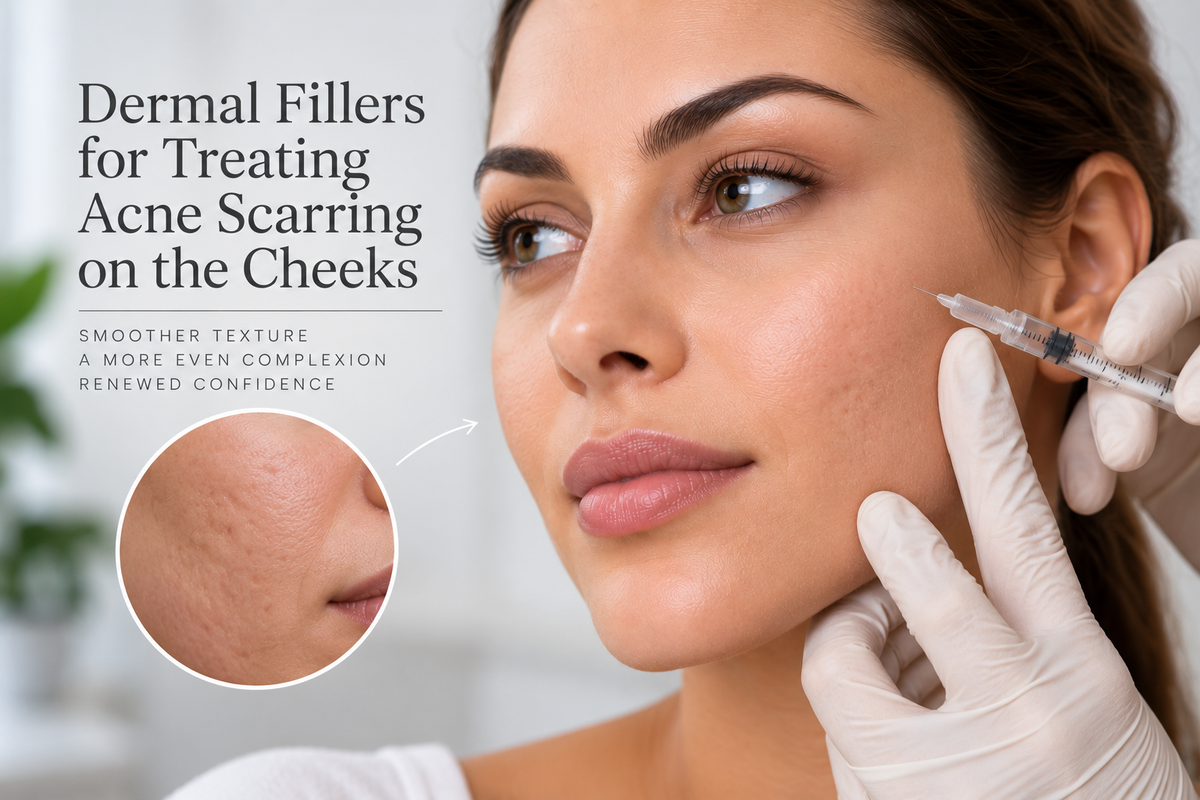
Dermal Fillers for Treating Acne Scarring on the Cheeks
Dermal Fillers for Treating Acne Scarring on the Cheeks
Understanding Acne Scarring on the Cheeks
Acne can leave lasting changes in the skin long after active breakouts have disappeared. For many people, the cheeks are particularly affected because inflammatory acne in this area can damage the deeper layers of the skin and leave visible depressions.
These depressed scars can create an uneven skin texture that becomes especially noticeable under certain lighting. Skincare products may improve the general condition of the skin, but established scars involving structural changes beneath the surface often require a different approach.
Dermal fillers for acne scars may be considered when selected scars have lost volume and sit below the surrounding skin. By carefully restoring support beneath these depressions, filler treatment can make certain cheek scars appear shallower and create a smoother overall contour.
Why Does Acne Cause Depressed Scars
Acne scarring develops when inflammation damages skin tissue during the healing process.
The body produces collagen as part of normal repair. When insufficient collagen is produced in a damaged area, a depression can remain after the acne lesion heals. These are known as atrophic acne scars.
Not every depressed acne scar looks the same.
Rolling Acne Scars
Rolling scars tend to create broad depressions with relatively soft edges. They can give the cheeks a wavy or uneven appearance.
Some rolling scars may be attached to deeper tissues by fibrous bands. This means filler alone may not always provide the desired correction.
Boxcar Acne Scars
Boxcar scars are typically wider depressions with more defined edges. Their depth can vary significantly.
Selected shallow or moderate boxcar scars may respond to treatments designed to improve the depression, although the most appropriate approach depends on individual scar characteristics.
Ice Pick Scars
Ice pick scars are narrow and extend more deeply into the skin.
Because of their shape and depth, dermal fillers are generally not the most suitable treatment for these scars. Other dermatological procedures may be considered instead.
This is why identifying the type of acne scarring is important before choosing a treatment.
How Dermal Fillers Can Improve Acne Scars
Dermal fillers are injectable materials used to restore volume and provide support within facial tissues.
When treating selected depressed acne scars, filler can be carefully placed beneath the scar to raise the depression closer to the level of the surrounding skin.
This does not erase the scar itself. Instead, it changes the contour responsible for some of its visibility.
When light falls across a deep depression, the resulting shadow can make the scar appear more pronounced. Reducing the depth may create a smoother surface and make the scar less noticeable.
Hyaluronic Acid Fillers for Acne Scarring
Hyaluronic acid fillers are commonly used in facial aesthetic medicine.
Hyaluronic acid is naturally present within the body and plays a role in tissue hydration. Injectable versions are formulated into gels with different physical properties.
For acne scarring, a healthcare professional may select a filler according to the depth of the scars, skin thickness, treatment location, and desired degree of correction.
One advantage of hyaluronic acid fillers is that treatment can be performed conservatively. Rather than attempting to completely eliminate every depression, small amounts may be used to improve selected scars while maintaining natural facial contours.
Can Fillers Permanently Remove Acne Scars
Dermal fillers should not be considered a permanent cure for acne scarring.
Many commonly used fillers are gradually broken down by the body. How long the improvement remains visible varies according to the product, injection depth, treatment area, individual metabolism, and other biological factors.
The underlying scar also remains present even when its appearance has improved.
Patients should therefore have realistic expectations. The goal is usually to reduce the visibility of suitable scars rather than produce completely flawless skin.
Combining Dermal Fillers With Other Acne Scar Treatments
Acne scarring is often complex, and a person may have several different types of scars on the same cheek.
For this reason, combination treatment may sometimes be considered.
A healthcare professional may recommend procedures that address scar attachments, skin texture, collagen remodeling, or deeper depressions depending on the individual's needs.
Subcision and Dermal Fillers
Some rolling scars are tethered to deeper tissues by fibrous bands.
Subcision is a medical procedure designed to release selected scar attachments beneath the skin. In appropriate cases, filler may be considered alongside or after this type of treatment to provide additional support beneath the depression.
The suitability and timing of combination procedures should be determined by a qualified professional.
What Happens During an Acne Scar Filler Treatment
Treatment should begin with an assessment of the skin.
The practitioner will evaluate the types of scars present, their depth, location, skin quality, and whether active acne is still occurring.
Medical history, medications, allergies, previous treatments, and individual goals should also be discussed.
If dermal filler is appropriate, the product is carefully injected beneath selected scars using a technique suited to the area.
Treatment time depends on the number and complexity of the scars being addressed.
What to Expect After Dermal Filler Treatment
Some improvement may be noticeable shortly after treatment because the filler provides volume beneath depressed areas.
However, swelling can temporarily affect the appearance of the cheeks. The final result should therefore be assessed after the tissues have had time to settle.
Temporary redness, swelling, tenderness, or bruising may occur around injection sites.
Patients should follow the aftercare instructions provided by their healthcare professional and avoid unnecessarily pressing or manipulating treated areas unless specifically instructed otherwise.
Are Dermal Fillers Suitable for Active Acne
Treating established acne scars is different from treating active acne.
Injectable procedures may not be appropriate in areas affected by active inflammation or infection. Introducing a needle through compromised skin can create additional concerns.
Patients who continue to experience significant acne should discuss this with a dermatologist or other appropriately qualified healthcare professional.
Controlling active breakouts can be an important step before focusing on scar correction because new inflammatory acne can create additional scars.
Risks and Side Effects of Acne Scar Fillers
Dermal filler injections are medical procedures and carry potential risks.
Common temporary reactions include bruising, redness, tenderness, and swelling. Irregularities or asymmetry can also occur.
More serious complications are uncommon but possible. Dermal filler can accidentally enter or compromise a blood vessel, potentially interfering with normal circulation.
The risk varies according to the treatment area and technique, but vascular complications require prompt recognition and management.
Severe or increasing pain, unusual changes in skin color, visual symptoms, or other unexpected reactions after treatment require immediate medical assessment.
Choosing the Right Practitioner
Treating acne scars with dermal fillers requires an understanding of both facial anatomy and scar structure.
Simply injecting filler beneath every depression is unlikely to provide the best result.
An experienced healthcare professional should be able to distinguish between scars that may benefit from filler and those better treated using another method.
Product selection, injection depth, amount of filler, and scar type all influence the outcome.
A conservative treatment plan can also help avoid unnecessary facial volume while focusing specifically on areas where structural correction may improve the skin surface.
Achieving Natural Looking Improvement in Cheek Acne Scars
Dermal fillers for treating acne scarring on the cheeks can be useful for carefully selected depressed scars, particularly when loss of support beneath the skin contributes to their appearance.
The treatment works by raising selected depressions and creating a smoother transition with the surrounding skin rather than removing the scar itself.
Results depend on the type and depth of scarring, product selection, injection technique, skin characteristics, and individual healing response.
Some patients may benefit from filler alone, while others require a combination of treatments to address different scar types.
The most effective approach begins with an accurate assessment. By identifying the characteristics of each scar and selecting treatment accordingly, an appropriately qualified healthcare professional can develop a plan focused on realistic, balanced, and natural looking improvement in cheek texture.

Stocking up for your clinic?
Fillers, skin boosters, collagen stimulators and more, packed and shipped from South Korea.

